 |
|
		Dual Spiral Systems Die Trials
		By far the most significant factor that affects mechanical properties of film aside from the actual materials in the film is the number of independent layers in the film structure. Among the benefits of increasing the number of layers are improved thickness distribution, better physical properties, and the ability to manufacture a wider variety of film structures.


		Doubling the number of layers in the film structure creates films that have improved flex crack resistance making the film softer with less curl in asymmetrical structures resulting in increased deep draw characteristics and improved thermoformability. Using two thin layers of the same material instead of one thick one reduces pinholes and improves consistency. Correspondingly, a coextruded film has higher melt strength and can be produced at a higher output rate with better bubble stability.


		Unlike micro layer dies that use only 2-3 different materials in the micro-layer structure, DSS dies can process several different resins through each individual layer in the die thus taking advantage of the properties of that unique resin.


		The experimental setup involves machinery to compare barrier films produced on different coextrusion dies of varying layer numbers. All other processing conditions including temperatures, draw down ratio (DDR), blow up ratio (BUR), frost line height (FLH), die gap, film structure, etc… remain the same. This research is done in conjunction with the Canadian National Research Council (CNRC).


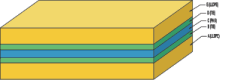
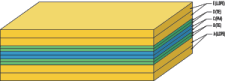
		The experimental analysis was to measure the physical properties between the 5 layer films made on the conventional stacked coextrusion die, and the Dual Spiral Systems die that divides each melt layer into two layers. The film from the DSS die is composed of a total of 10 layers in the following arrangement AA/BB/CC/DD/EE while the film from the conventional coextrusion die is A/B/C/D/E.(see below)


		Please contact Dual Spiral Systems if you wish to receive full experimental details on the findings from our various research investigations.
|
|
|  |